





News

USCIS Posts Alerts Indicating Ukrainians with TPS Can Stay and Work but Has Not Published Any Extension After October 19th Expiration Date
On Monday, October 19, 2026, USCIS posted an alert on its main TPS page stating that “an announcement on Ukraine’s TPS will be made at the appropriate time. Until such announcement is made, Ukrainian individuals present in the U.S. under TPS retain protection including work authorization.” However, USCIS has not yet issued clear instructions on how employers should update Form I-9 files or handle reverification in the absence of an official notice. Similarly, because backend system updates have not been implemented, automated verification systems, such as SAVE (for driver’s licenses and state benefits) and E-Verify (for employment), are still processing October 19, 2026, as the hard expiration date for TPS.

Are U4U Parolees Allowed to Work with Pending Re-Parole?
Many Ukrainians have applied for re-parole but have yet to receive approvals. After waiting several months and even a year or more, some risk losing their only lawful status that allows them to remain in the United States. Others already live in limbo with expired parole. For those whose sole source of employment eligibility is through humanitarian parole, they could lose their jobs and the ability to support themselves. What are their legal options, and how can those at risk ensure they remain compliant with the law? USCIS provides some alternative methods to proving employment authorization. Those who have received a final grant of re-parole but are still awaiting new EAD cards may show a valid unexpired I-94 with a “UHP” class of admission for up to 90 days. Other parolees may have employment eligibility through TPS or pending applications for asylum or adjustment of status.

Ukrainian Truck Drivers at Risk Due to New Final Rule that Restricts Noncitizen Eligibility for Commercial Driver’s Licenses
A new rule that went into effect March 16, 2026 severely restricts which categories of noncitizens are eligible to hold Commercial Driver’s Licenses (CDLs) that are required to drive trucks and other commercial vehicles. States may ONLY issue or renew Non-Domiciled CDLs/CLPs to drivers who have an H-2A, H-2B, or E-2 visa. Simply having an Employment Authorization Document (EAD) is no longer sufficient. This means Uniting for Ukraine (U4U) humanitarian parolees and TPS grantees are no longer eligible to apply for or renew CDLs/CLPs, even if they previously held or currently hold a valid one. Ukrainians driving commercial vehicles who do not have an H-2A, H-2B, or E-2 work visa and a valid CDL are also at greater risk of being stopped, inspected, or detained by police or state transportation authorities.
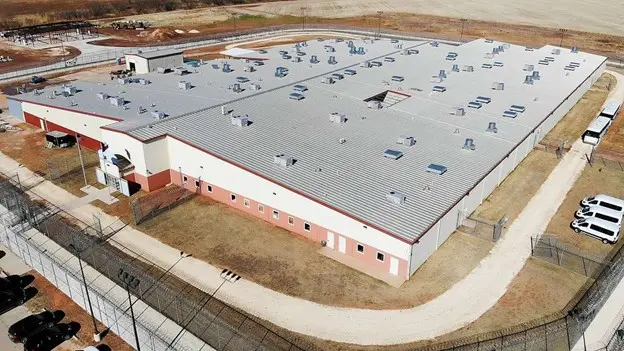
How to Locate and Get Help for Someone in Immigration Detention
Hundreds of Ukrainians have been held in immigration detention, with the numbers increasing dramatically in the past year. Learning that a family member or someone close has been detained can be frightening and stressful, especially when you don’t know where they are being held. Find out which categories are at risk, how you can locate someone at an ICE detention center or a state/local correctional facility, where to find legal counsel to assist them, how to try to get them released from detention, and additional resources for detainees and their families.

Submitting Evidence of Urgent Humanitarian Reasons for Re-Parole
Whether you are preparing to apply for re-parole or recently received a Request for Evidence (RFE) after filing Form I-131, you will need to submit sufficient evidence to USCIS demonstrating that 1) there are continued urgent humanitarian reasons or significant public benefit for you to be issued a new period of humanitarian parole, and 2) that you personally warrant a favorable exercise of discretion of parole. Learn how to write an effective affidavit explaining why you need to stay in the U.S. on humanitarian parole and which evidence is helpful to support it.
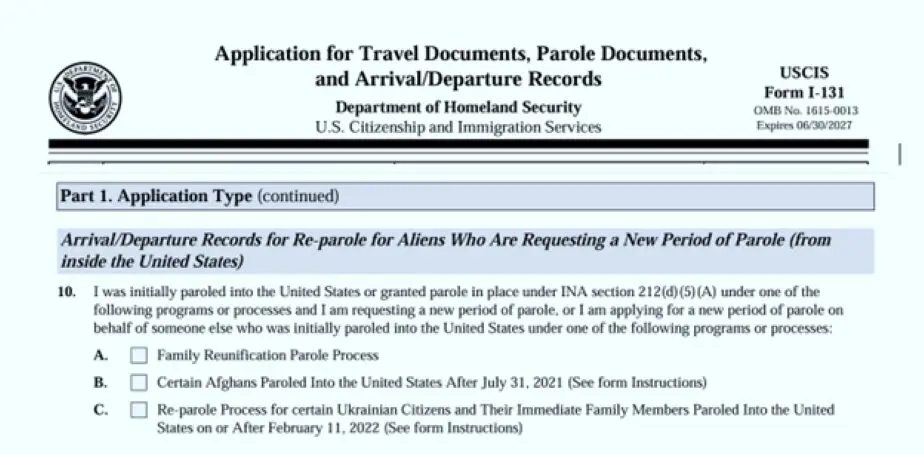
Applying for Re-Parole: Updates and Recommendations for Ukrainian Parolees
In June 2025, USCIS resumed processing re-parole and other applications filed by parolees. Although Ukrainians are no longer able to use the streamlined re-parole process that was previously available, they can still apply for re-parole by filing Form I-131 online or by mail and submitting all the required documentation to USCIS. Their re-parole requests will be considered on a case-by-case basis after examining their individual circumstances to determine if another grant of parole is warranted for urgent humanitarian reasons or significant public interest. Learn more about re-parole, who is eligible, how to apply, how to renew employment authorization, and recommendations for filing a strong application.

Can Ukrainians Seek Asylum in the United States?
Individuals seeking political asylum in the United States must file an Application for Asylum and for Withholding of Removal within one year of their arrival to the United States, though there are a few limited exceptions to the one-year filing deadline. In addition to the one-year filing deadline, there could be other bars to asylum such as firm resettlement in another country or criminal history. A person may apply for asylum in the United States regardless of their country of origin or their current immigration status. In order to apply for asylum protection, applicants must show….
Remaining in the United States after Uniting for Ukraine (U4U): Options for Humanitarian Parolees
Many Ukrainians who entered the United States through the Uniting for Ukraine program are wondering how they might be able to remain in the United States after their humanitarian parole expires. Here are some potential options that could allow certain Ukrainians on humanitarian parole to remain in the United States after their Uniting for Ukraine stay ends.

Can U4U Humanitarian Parolees Apply for Employment-Based Permanent Residence (Green Cards)?
Adjustment of Status is the process by which a noncitizen who is already in the United States can apply for Lawful Permanent Resident status (a Green Card) without having to leave the country. However, strict legal requirements limit the eligibility for this process for humanitarian parolees and other categories of applicants.
Initiatives
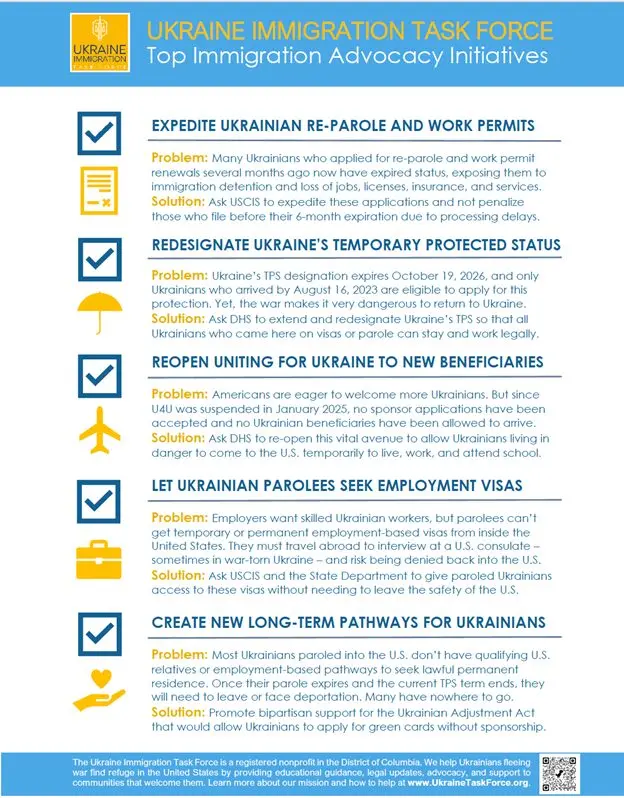
Top Immigration Advocacy Initiatives
Please help the Ukraine Immigration Task Force:
- promote efficient immigration pathways for Ukrainians seeking refuge in the United States
- advocate for the protection of vulnerable individuals and families, and
- help new arrivals access the tools and resources they need to become self-sufficient
Learn more about our initiatives to help Ukrainians fleeing war find safety and security in the United States!
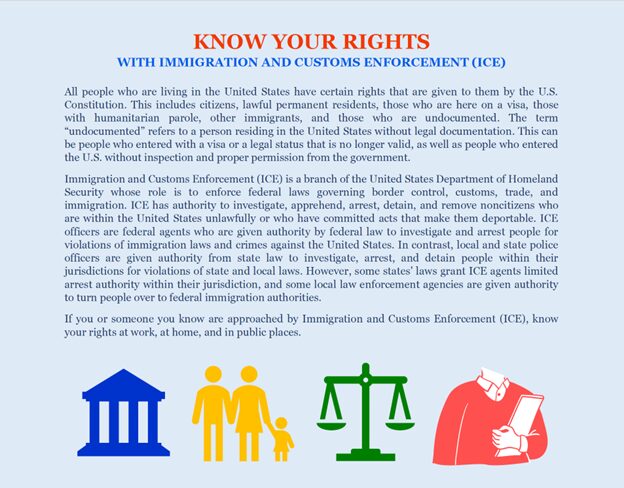
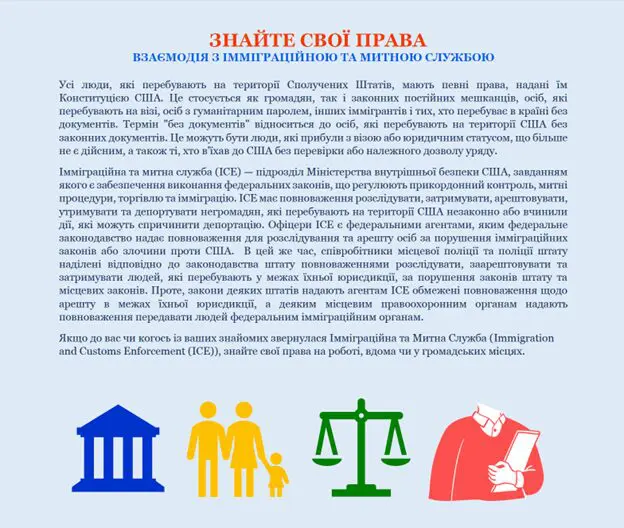
Know Your Rights with Immigration and Customs Enforcement
All people who are living in the United States have certain rights that are given to them by the U.S. Constitution. This includes citizens, lawful permanent residents, those who are here on a visa, those with humanitarian parole, other immigrants, and those who are undocumented. Immigration and Customs Enforcement (ICE) has authority to investigate, apprehend, arrest, detain, and remove noncitizens who are within the United States unlawfully or who have committed acts that make them deportable. If you or someone you know are approached by ICE, know your rights at work, at home, and in public places.
Read and download Know Your Rights flyers in English, Ukrainian, and Russian here:
Know Your Rights with Immigration and Customs Enforcement
Information For Arriving Ukrainians
Settle In for Ukrainians
Settle In is a free and publicly available resource for new arrivals. Settle In provides vital information about early resettlement services, employment, housing, education, healthcare, culture, and life in the United States.

Virtual Resettlement Line for Ukrainians
The Virtual Resettlement Line (VRL) is a one-stop resource for Ukrainian newcomers who are not yet connected to a resettlement agency or need help accessing benefits or resources in their communities. Assistance is available in Ukrainian and Russian to help new arrivals learn how to:
- Access federal mainstream and refugee benefits
- Receive help with immediate needs such as food insecurity
- Connect to resources in their communities
- Obtain referrals to local resettlement agencies for eligible clients
- Request cash assistance for eligible callers
- Get answers to general questions
The VRL is an initiative of the International Rescue Committee and supported by NRC-RIM.